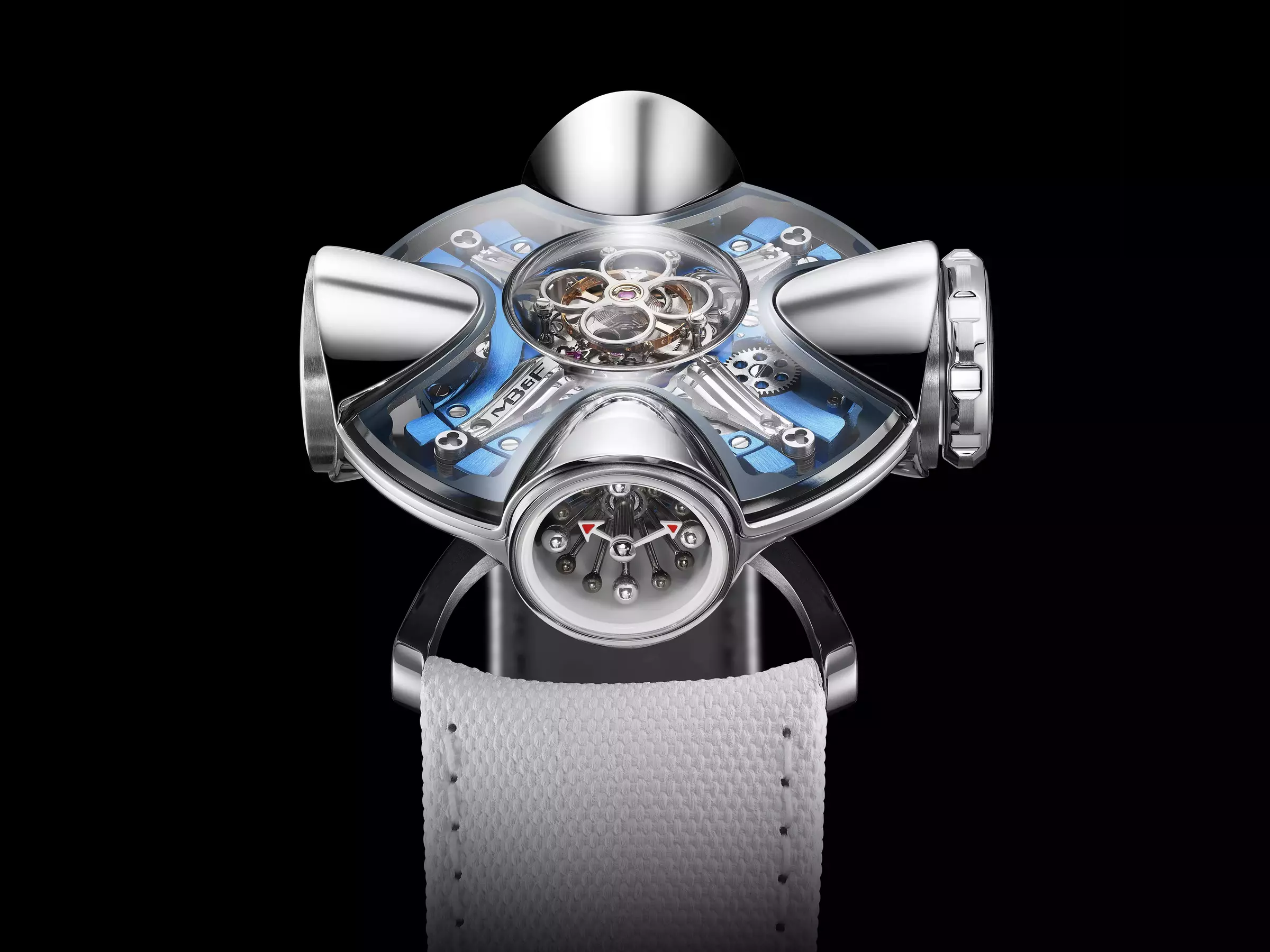
Horological Machine N°11
Architect & Art Deco
It could be said that an MB&F Machine is not worn; it is lived. With its latest creations, MB&F further blurs the line between watchmaking and architecture.

The house that Max built
A watch and a house are different machines.
But the Machines of MB&F are habitable; the stories they tell locate us in different places or different times, and sometimes different worlds.
What's so special about this machine?
A rotating case, a flying tourbillon and a see-through sapphire crown are just three highlights from the HM11's unique features.

A ROTATING CASE TO DISPLAY FUNCTIONS & WIND THE MOVEMENT
Turn the house to access each room; the entire structure rotates on its foundations, simultaneously winding the movement. The 90° angle of offset between each room means that you can position HM11 with one of its rooms directly facing you, or with one of the corridors of the house running towards you and rooms obliquely to each side.

A SEE-THROUGH SAPPHIRE CROWN
An unprecedented feature in watchmaking is the see-through crown, close to 10mm in diameter, that allows an unimpeded view directly into the movement. A crown of this size in sapphire crystal, whilst undeniable in its aesthetic impact, comes with specific technical challenges to be overcome. As the primary point of ingress to the movement, a watch crown must be equipped with gaskets that prevent water or dust particles from entering the watch and compromising its performance.

A CENTRAL FLYING TOURBILLON
A central flying tourbillon forms the heart of the house, pushing skyward under a double-domed sapphire roof. Fittingly, for a mechanism that is spatially and functionally at the origin point of the watch, its quatrefoil-shaped upper bridge recalls the shape of clerestory windows in some of humanity’s greatest temples to its Creator, or perhaps the shape of a zygote undergoing cell division at the moment of conception. From this spinning core, four symmetrical volumes reach outwards, creating the four parabolic rooms of the house that is HM11 Architect.
Machine in action
“Une maison est une machine à habiter.”


What if a house was a watch?
A central atrium that gives onto four peripheral rooms. Transparency and light. Interior volumes that interact with exterior perspectives, HM11 combines the beauty of architecture with watchmaking mastery.
HM11 Architect (2023 editions) – limited to 25 pieces each:
- in titanium with blue dial plate;
- in titanium with rose gold dial plate.
HM11 Art Deco (2025 editions) – limited to 10 pieces each:
- in titanium with blue dial plate and 3N yellow gold toned bridges;
- in titanium with green dial plate and 5N rose gold toned bridges.
Grade 5 titanium
Display markers (HM11 Architect): conical rods in stainless steel (Ø 0.50mm to 0.60mm), darker beads in polished titanium and lighter beads in polished aluminium (Ø 1.30mm to 2.40mm).
Display markers (HM11 Art Deco): laser-cut circular grained markers in 5N PVD for the green model, 3N PVD for the blue model
Hands (HM11 Art Deco): White gold skeleton hands with transparent red enamel insert
Dimensions: 42mm diameter x 23mm height
Number of case components: 92 components
Water resistance: 20m / 68’ / 2ATM
Three-dimensional horological engine featuring flying tourbillon and bevel gears, developed in-house by MB&F.
Mechanical movement, manual winding (by turning the entire case clockwise)
Power reserve: 4 days (96 hours)
Balance frequency: 18’000bph/2.5Hz
Plates: Blue and 5N PVD treatment for HM11 Architect / Blue and green PVD treatment for HM11 Art Deco
Bridges: rhodium-plated for HM11 Architect, 5N or 3N PVD for the HM11 Art Deco
Number of movement components: 364 components for HM11 Architect and 330 components for HM11 Art Deco
Number of jewels: 29 jewels
Sapphire crystals on top, back, and on each chamber-display treated with anti-reflective coating on both faces
Sapphire crystal time-setting crown
- Hour and minutes
- Power reserve
- Temperature (-20 to 60° Celsius, or 0 to 140° Fahrenheit)
HM11 Architect: rubber strap – white for the blue model and khaki for the rose gold model.
HM11 Art Deco: lizard strap – white for the blue model and beige for the green model.
Titanium folding buckle.

Inspiration
When MB&F unveiled Horological Machine N°11 in 2023, it redefined what a watch could be: a piece of wearable architecture.
Conceived by Maximilian Büsser and designer Eric Giroud, HM11 drew inspiration from the organic, neo-futuristic architecture of the 1960s and ’70s. For 2025, designer Maximilian Maertens revisits this structure through a new lens — that of 1930s Art Deco — creating the next chapter in the series: HM11 Art Deco.
The original HM11 Architect
“A house is a machine to live in,” wrote Le Corbusier – a maxim MB&F made literal with HM11. The Machine transformed the idea of a “watch case” into a miniature home: four symmetrical rooms radiating from a central atrium crowned by a flying tourbillon beneath a double-domed sapphire roof.
The new HM11 Art Deco
The new HM11 Art Deco builds on the same foundations while adopting a distinct visual language. Guided by Maximilian Maertens’ fascination with early-20th-century architecture – from Parisian cinemas to Manhattan skyscrapers – the design trades the organic fluidity of the Architect for the geometry and rhythm of the Art Deco movement.


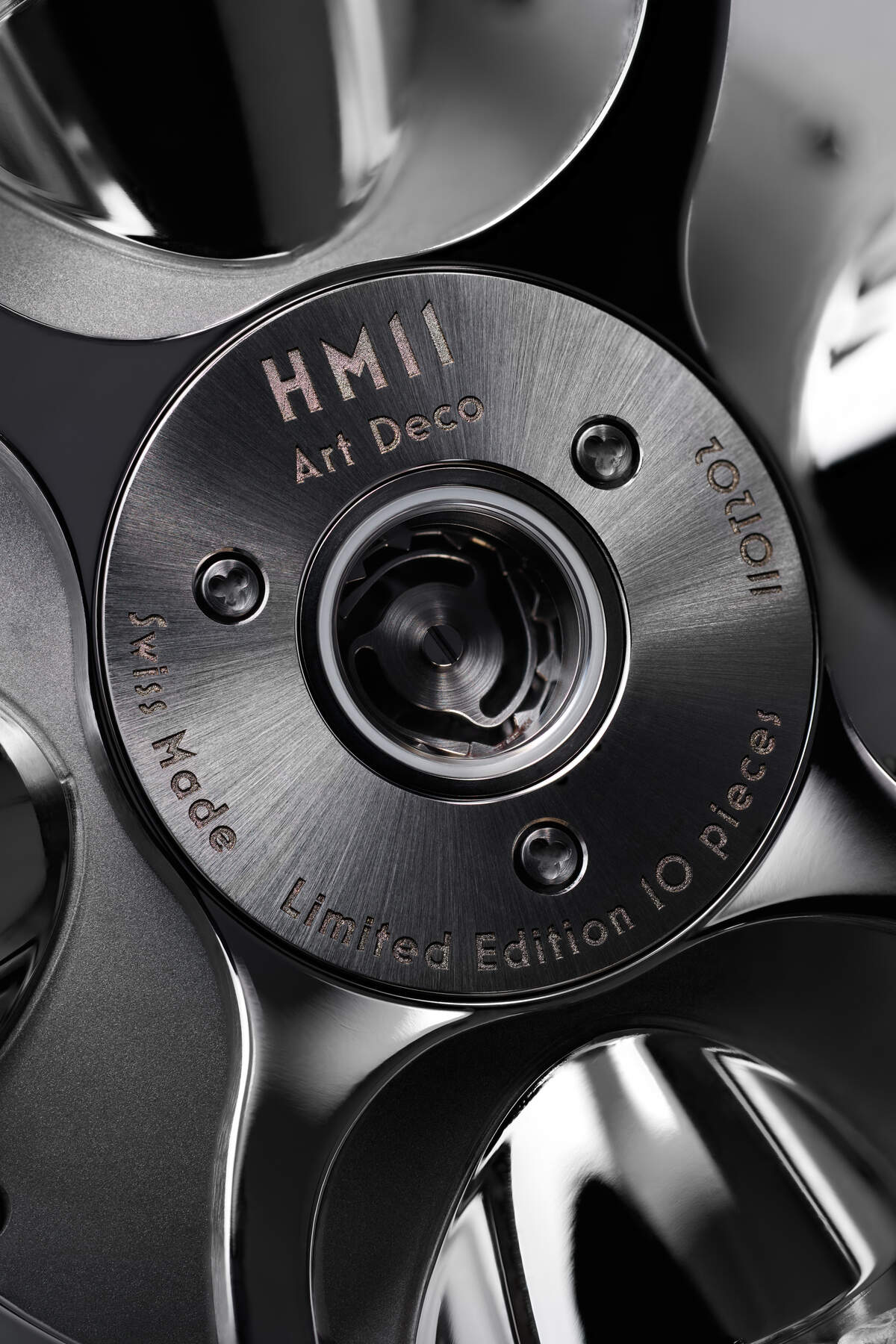


Discover the models available for this collection
Continue to
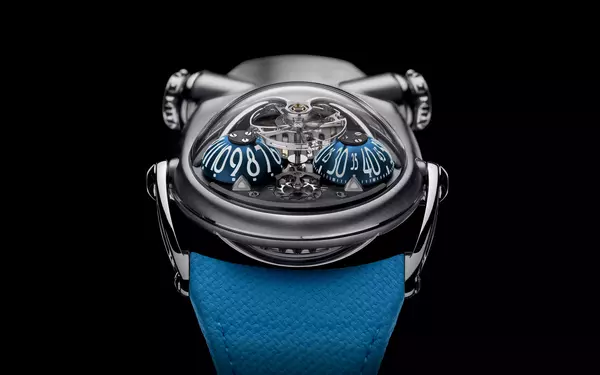
Horological Machine N°10

Horological Machine N°9